Durable jobs and DAG workflows on the Postgres you already run.
QueueFlow is a PostgreSQL-native distributed job queue and workflow engine. No Redis, no broker, no separate state store. The jobs table is the queue, and workers in any language talk to it over HTTP.
import { QueueFlow, wf } from"@queueflow/sdk";
const qf = newQueueFlow({ baseUrl: "http://localhost:8000", token: process.env.QUEUEFLOW_TOKEN });
// Enqueue a job with retries and a timeout, then wait for the result.const job = await qf.jobs.create({ task: "resize_image", payload: { id: 42 }, maxRetries: 3, timeout: 30 });
const done = await qf.jobs.waitFor(job.id);
// Declare a DAG. Each step runs once its dependencies complete.const run = await qf.workflows.create(
wf("etl")
.step("extract", "fetch_rows")
.step("transform", "normalize", { after: ["extract"] })
.step("load", "upsert", { after: ["transform"], onFailure: "halt" }),
);
const finished = await qf.workflows.waitFor(run.id);
console.log(finished.status, finished.context);
Features
Everything a job system needs, with nothing to add to your stack.
Any plain PostgreSQL 13 or newer works: RDS, Cloud SQL, Azure, or your laptop. No extensions required.
PostgreSQL native
Workers claim rows with FOR UPDATE SKIP LOCKED and own them through lease tokens. Durable, transactional, at-least-once delivery with no extra infrastructure.
Workflows as real DAGs
Declare steps and dependencies. The engine gates each step, threads results through a shared context, and applies per-step failure policies: halt, skip, or continue.
Durable retries
Fixed, linear, or exponential backoff with caps and jitter. A retry is just a row scheduled in the future, so delays survive restarts.
Dead-letter queue
Exhausted and non-retryable jobs land in an inspectable DLQ. Replay any entry as a fresh job from the API.
Cron schedules
Recurring enqueues from standard crontab expressions, deduplicated across servers, with pause and resume.
Polyglot workers
A lease, heartbeat, complete, and fail HTTP protocol lets handlers run in any language with the same retry, DLQ, and workflow semantics as in-process Rust handlers.
Observable
Prometheus metrics, structured JSON logs, health and readiness probes, and a Server-Sent Events stream of job status changes.
Code-generated OpenAPI
The OpenAPI 3.1 spec is derived from the handlers and ships with every release, so clients never drift from the server.
Multi-tenant and idempotent
Tenant isolation is enforced on every job and workflow endpoint. An Idempotency-Key header makes client retries safe.
How it works
Point it at a database. Enqueue. Drain.
The engine applies migrations on startup and exposes a REST API, Prometheus metrics, and interactive docs.
1
Run the engine against Postgres
Start the server with a DATABASE_URL. It applies its own migrations, serves the API on port 8000, and runs workers in the same process or separately.
2
Enqueue jobs or declare a workflow
Use the REST API or an SDK. Set priority, retries, backoff, timeouts, and a future run_at. Workflows are plain JSON with depends_on edges; cycles are rejected at creation.
3
Workers lease, heartbeat, and report
Handlers in any language lease jobs from a queue, extend the lease while working, and complete or fail with a retryable flag. Crashed workers consume retry budget instead of crash-looping.
curl
# Start the engine (any plain Postgres 13+). --dev accepts any bearer token;# in production pass --api-keys and --worker-token instead.export DATABASE_URL=postgres://postgres:postgres@localhost:5432/postgres
queueflow serve --dev --mode all --workers 10 --api-port 8000
# Enqueue a job
curl -X POST http://localhost:8000/api/v1/jobs \
-H 'Authorization: Bearer dev' -H 'Content-Type: application/json' \
-d '{"task_name":"echo","payload":{"hello":"world"},
"config":{"priority":5,"max_retries":3,"timeout":30}}'# => {"job_id":"…"}# Lease work from any language (long-polls when the queue is empty)
curl -X POST http://localhost:8000/api/v1/queues/default/lease \
-H 'Authorization: Bearer dev' -H 'Content-Type: application/json' \
-d '{"max_jobs":1,"lease_secs":60,"wait_secs":20}'# Report the outcome
curl -X POST http://localhost:8000/api/v1/jobs/<id>/complete \
-H 'Authorization: Bearer dev' -H 'Content-Type: application/json' \
-d '{"lease_token":"…","result":{"ok":true}}'
Dashboard
See what is running without leaving the browser.
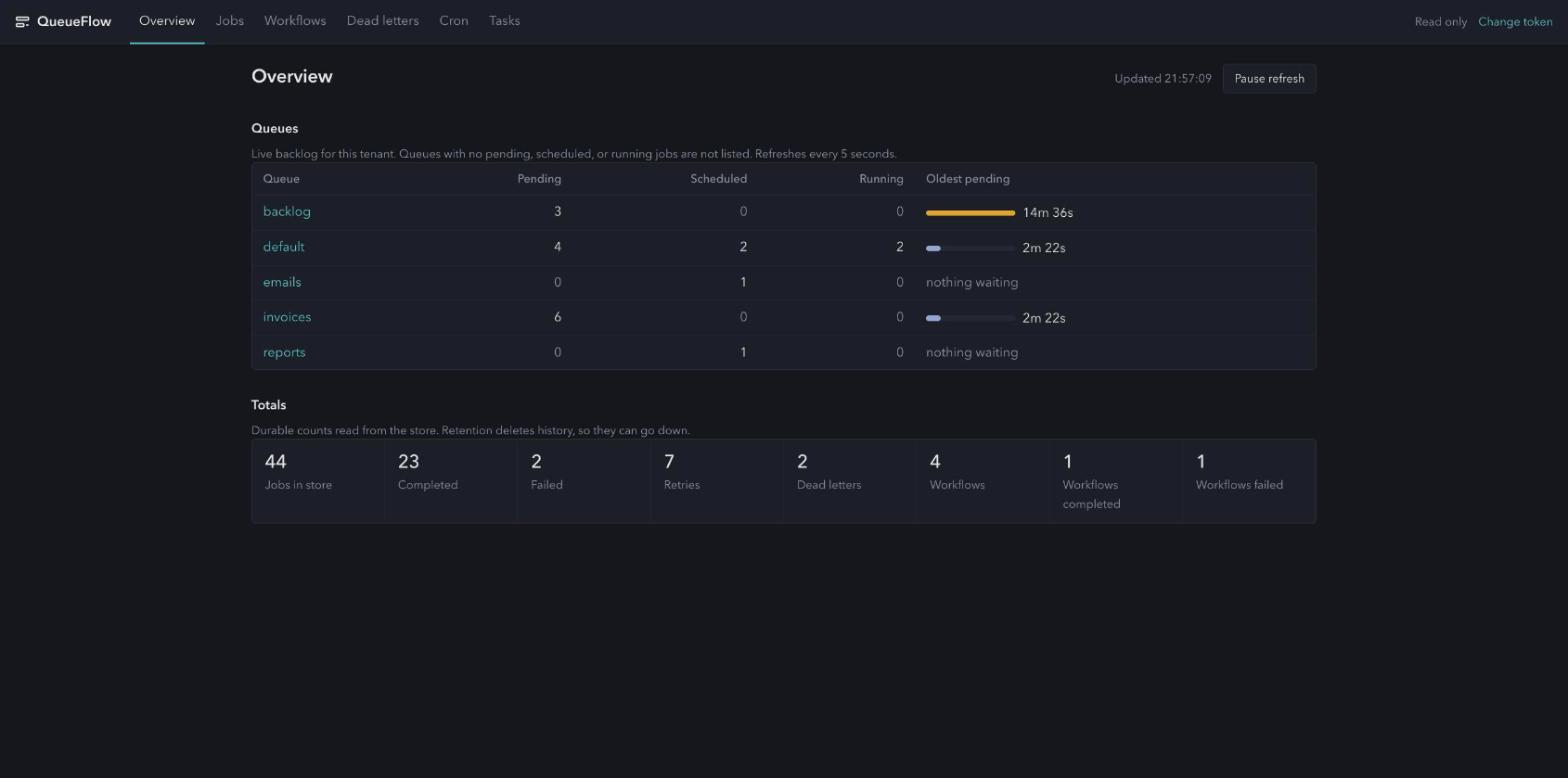
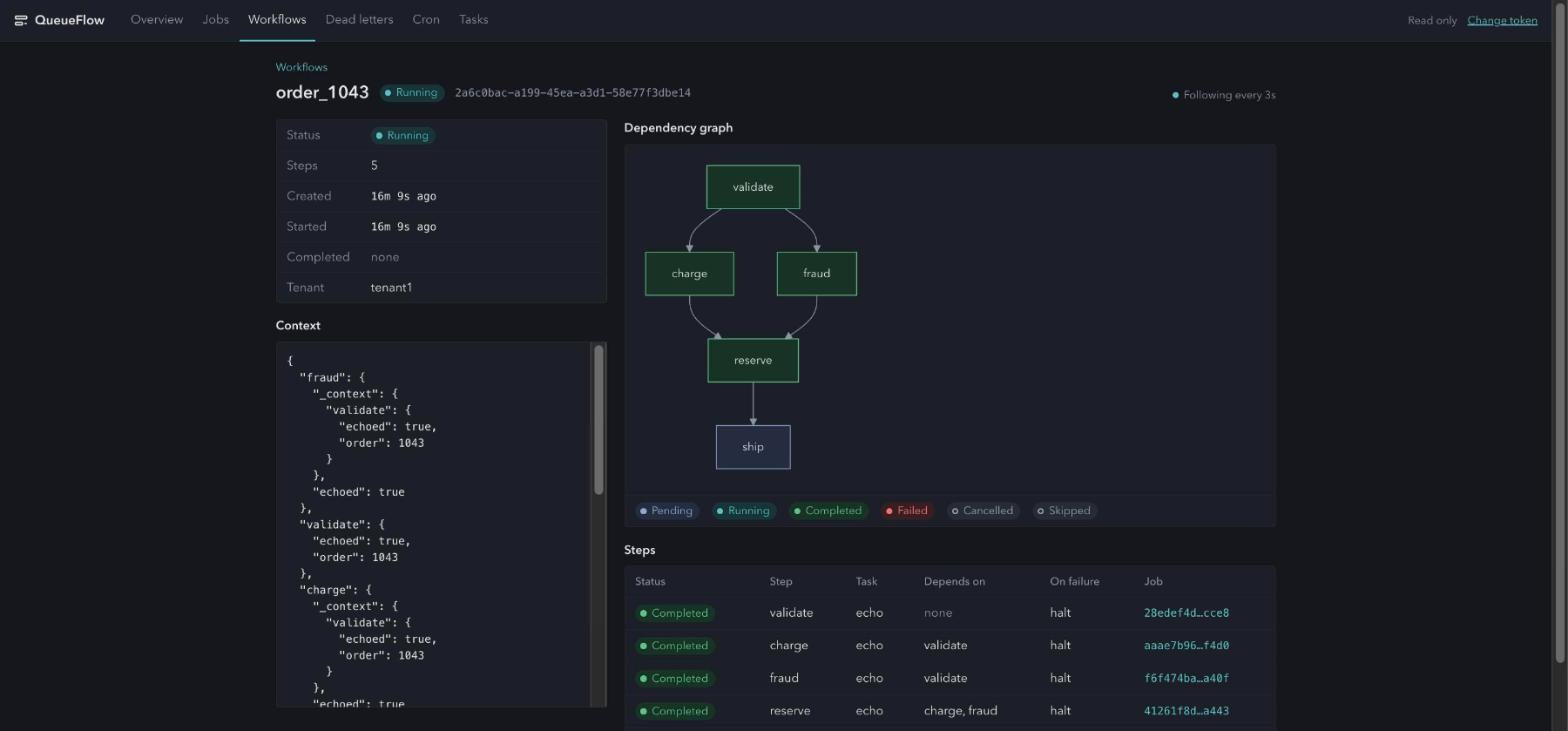
Every server ships a read-only dashboard at /ui/: per-queue backlog with the age of the oldest waiting job, jobs with live status, workflow graphs coloured by step state, dead letters, and cron schedules. No extra service, no build step. Read about the dashboard.
Overview: backlog per queue, refreshed every five seconds.Workflows: the DAG, coloured by step state, following live.
SDKs
Clients for the languages you already use.
Each client pairs a core generated from the released OpenAPI spec, so types never drift from the server, with a hand-written facade for the ergonomics codegen cannot give you. Anything else can be generated from the spec in minutes.
Start Postgres in Docker, run the quick start, and have a DAG running in a few minutes. Embedding the engine as a Rust library? It also runs against an in-memory store for tests.